
In 2026, the nature of online harm has undergone yet another mutation. While political misinformation remains a major threat to communities worldwide, a more immediate, predatory threat contributes to the “broader erosion of trust in digital systems”: Online scams.
A few days ago, as our team was evaluating Suwali’s responses to end-users, a researcher at Meedan highlighted that some of the earliest machine learning use cases from the 1990s focused on detecting spam email. These early classifiers relied on obvious, static markers such as phrases like “FREE VIAGRA”, the overuse of capital letters, or excessive exclamation marks. Scammers in the age of generative AI are creating personalized, polished scams that are harder to detect. Thirty years into the fight against spam, the crude junk mail of the 1990s looks almost quaint.
According to data from the Global Anti-Scam Alliance (GASA), global fraud losses have reached a staggering $442 billion annually, with AI-enhanced fraud now 4.5 times more profitable than traditional methods. These fraudulent operations function as a highly regressive tax, disproportionately stripping assets from low-resource and digitally vulnerable communities. They also feed a broader erosion of trust in digital systems. As central banks and global enforcement agencies are struggling to keep up, traditional fact-checking organizations are rapidly evolving into defensive anti-scam operations.
If AI has made scams easier to produce, it can also make protection easier to reach. Following the successful pilot of Suwali, we are thrilled to spotlight the Scamguard bot by The Quint: a specialized chatbot that uses generative AI responsibly to combat financial and digital fraud.
A Mission-Driven Response to Digital Scams
The Quint partnered with Meedan to transform static digital literacy guides and explainers into a dynamic, real-time shield. Their Scamguard initiative leverages Suwali’s chatbot infrastructure, turning their archival library of fraud research into a fluid, multilingual WhatsApp assistant that responds to inquiries about potential scams before harm is caused.
Scamguard emerges from the same collaborative spirit that guided our early adopters of Suwali in journalism and health rights: As harmful content and misinformation proliferate, the answers people need are often buried behind algorithmic filters or deep inside long PDF guides. Additionally, many people spend more time interacting with chatbots than visiting a trusted organization’s website.
“News content has shifted from websites on your desktop to social media platforms to news apps. And now it’s moving to messaging services like WhatsApp and Telegram… We have understood that the audience is not just wanting to engage with the content, but wants to interact with the content as well,” says Abhilash Mallick, the editor of the fact-checking team at The Quint. The Quint’s WhatsApp chatbot adapts to this sweeping behavioral change because Suwali supports direct two-way interaction, allowing users to query specific messages they have received or request more information about emerging scamming tactics. This direct communication model does more than just provide answers; it helps The Quint’s team understand scammers’ evolving tactics and inform broader community safety initiatives.
Scaling Protection with Natural Language
One of the primary challenges in fraud prevention is the volume of unique, localized scams. The Quint’s bot is built to handle queries with nuance and speed: Before launching the bot, The Quint developed over 40 structured resources in both English and Hindi that explain the anatomy of distinct scams spreading online, as well as ways to protect oneself from them.
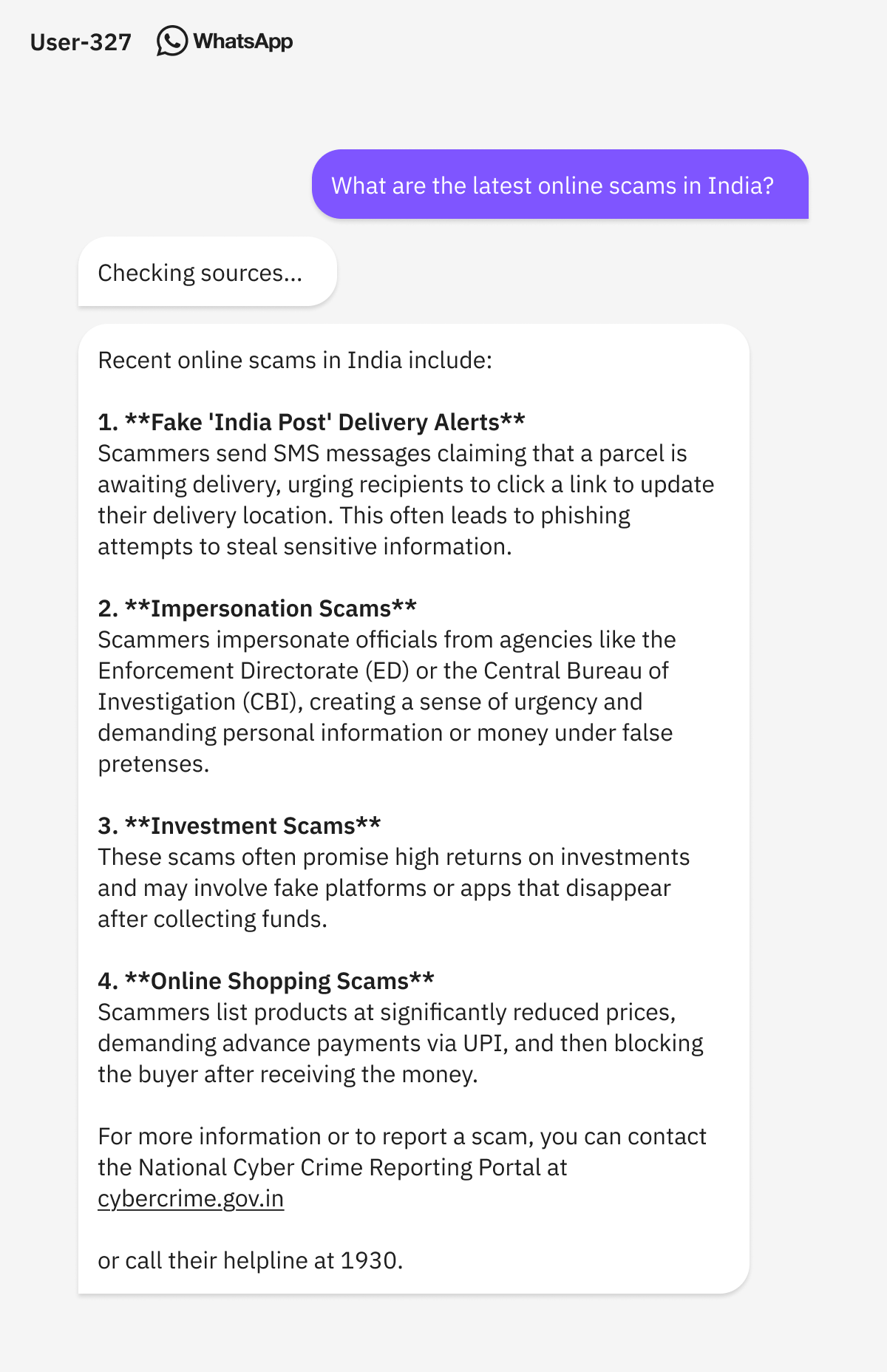
Scamguard answers a question about the latest online scams in India (anonymized WhatsApp conversation)
Grounded in these resources, Scamguard shifts user behavior from passive reaction to active verification. The chatbot operates at two levels: it serves as a pre-exposure educational tool, and provides multilingual personalized support to potential victims of fraud as they are being targeted, while suggesting helpful remedies, such as reaching out to public helplines and reporting mechanisms.
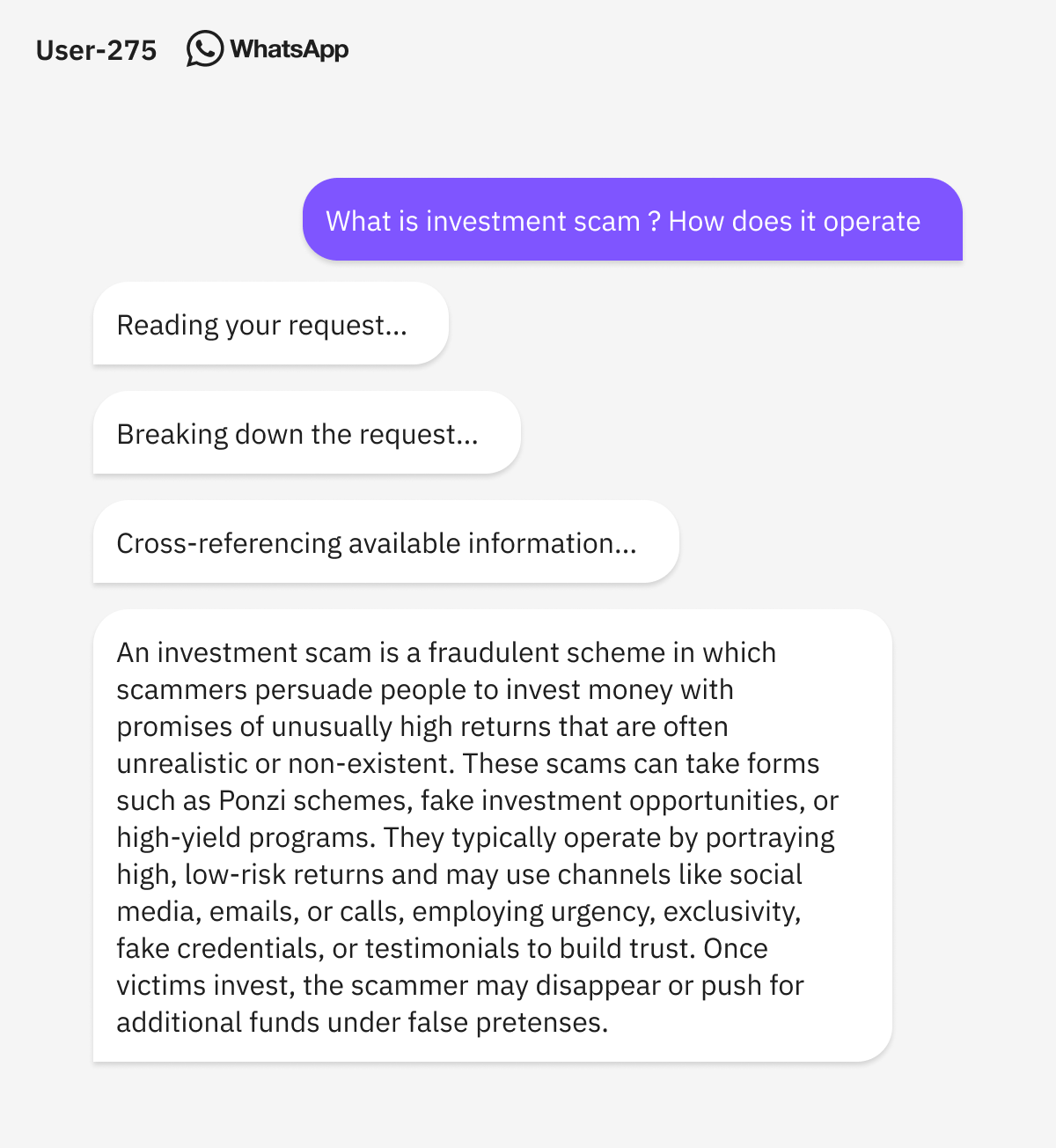
Scamguard explains how investment scams operate (anonymized WhatsApp conversation)
And because scammers rely on universal psychological and technical patterns, the architecture is inherently scalable. In other words, The Quint’s team doesn’t need to publish a unique article for every new variation or localization of an existing scam.
To illustrate, the example below shows an interaction between a user and the Scamguard bot in which the user asked Scamguard about a message they had recently received. Though it had never seen this exact message before, Suwali flagged structural linguistic cues to issue a defensive “Caution” warning, effectively neutralizing fraud patterns rather than just individual schemes. One thing to clarify here is that the bot did not hallucinate, fall back to general reasoning or use a large language model to come up with a response; its response is grounded only in The Quint’s sources that detail, among other things, the anatomy of a scam.
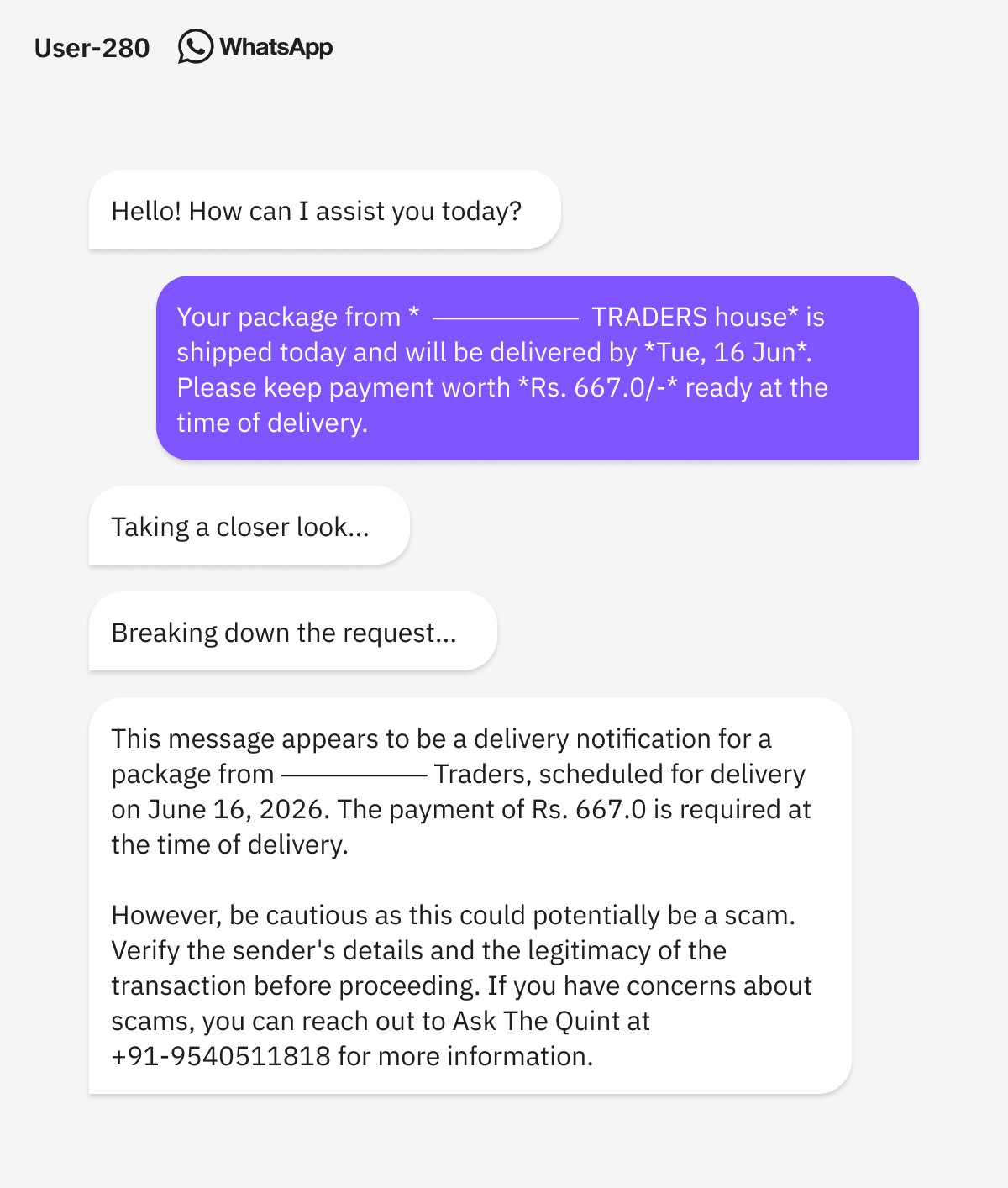
Scamguard flags a suspicious message a user received (anonymized WhatsApp conversation)
Building a Safer Future Together
At Meedan, we believe that the best resources are built with partners and their communities. We see Scamguard as a collaborative shield, grounded in The Quint’s own resources and designed to evolve alongside the communities it protects. And as we expand this project, we remain committed to supporting organizations that deliver critical information to their communities.
To see Scamguard in action, say hello to the bot on WhatsApp by clicking the link: +91 88268 11818. Organizations interested in adding Suwali to their community’s digital safety toolkit can send us a message.